Blogs
What Is a Ring Enhancer? How It Works and How to Choose One


If you love your solitaire but wish it had a little more going on, a ring enhancer is the simplest change you can make. It sits against your ring, adds diamonds around the center stone, and leaves the original ring exactly as it was.
Table of Contents
ToggleThis guide explains what an enhancer is, how it differs from a ring guard and a wedding band, how to tell whether it will fit your ring, and how to wear it. It works whether you buy yours with us or somewhere else.
What is a ring enhancer?
A ring enhancer is a curved or two-piece band, usually set with diamonds, that fits against a solitaire engagement ring so the two look like one ring. The engagement ring stays unchanged. Enhancers can be worn with a wedding band or in place of one, as long as the shape fits your ring.
Ring enhancer, wrap, guard, jacket: what is the difference?
Jewelers use these words loosely, so product pages often swap them. This is how they are usually used.
| Term | What it is | Worn with an engagement ring? | Good to know |
|---|---|---|---|
| Ring enhancer | A band made to sit against a solitaire and add diamonds or metalwork | Yes | The umbrella term. Can be a wrap or an insert |
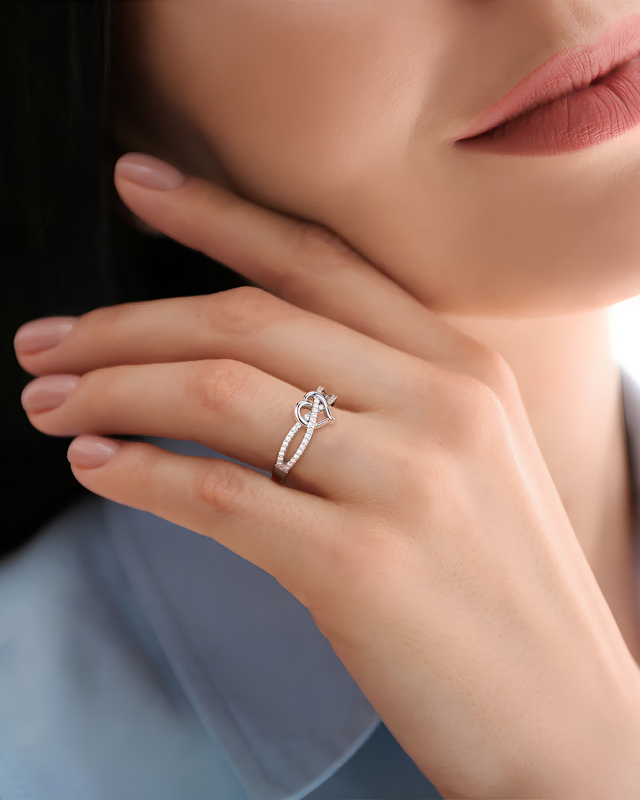
| Ring wrap | One band that curves around the center stone, with diamonds on both sides | Yes | Often called a curved band |
| Insert or jacket | A split, two-part band with a gap the engagement ring slides into | Yes | Needs an exact fit |
| Ring guard | A simpler band worn beside a ring, mainly to protect it | Yes | Many stores use "guard" and "enhancer" for the same piece |
| Wedding band | A plain or diamond band, often straight | Yes | Sits flat and does not contour to the ring |
| Contour band | A wedding band with a gentle curve | Yes | Curved to sit close to the ring. Wraps usually add more diamond detail |
If a listing says only "enhancer", ask whether it is a wrap or an insert, then bring your ring so we can check the match. Comparing it with other band styles? Our guide to eternity bands, wedding bands and anniversary bands lays out the differences.
The 3 types of ring enhancers
Ring wrap
A single band that curves around the center stone, with diamonds on both sides of it. The pair reads as one wider ring, and your engagement ring sits in the curve. This is the most common style.
Insert or jacket
A split band in two parts, with a gap between them. Your engagement ring slides into the gap, and accent stones often frame the center stone from both sides. Because the insert holds your ring between two bands, the fit has to be exact. Try it with your ring on.
Simple guard
A plain or lightly set band that curves to match your ring. It adds less sparkle than a wrap. It suits you if you want a quieter look or a band that is comfortable for everyday work.
What a ring enhancer can and cannot do
An enhancer can:
- Add sparkle and visual size without resetting your diamond.
- Keep the ring you already have. If your solitaire was a gift, a family piece, or simply the ring you love, nothing about it changes.
- Add metal along the sides of the center stone, which can take a light knock before the stone does.
- Double as a wedding band or an anniversary gift.
An enhancer cannot:
- Make a ring damage-proof.
- Fix a loose or worn prong. That needs a jeweler. See our repair services for prong checks and re-tipping.
- Fit every ring. That is the next section.
Will an enhancer fit my ring?
Fit is the one thing that matters most. An enhancer is shaped for a particular kind of ring, and a gap or a wobble is the usual sign of a mismatch. These are the things a jeweler looks at.
| What to look at | Why it matters | What to check |
|---|---|---|
| Setting style | Solitaires fit best. Halos, tension settings and very detailed vintage rings often cannot take a standard enhancer | Ask a jeweler before you buy |
| Setting height | A stone that sits close to the band leaves little room for the curve | Look at the ring from the side |
| Prongs and stone shape | Corners and points (marquise, pear, princess) need clearance | The enhancer should clear the prongs, not press on them |
| Band shape | The enhancer must sit flush against the sides of your band | No gap, no rocking |
| Ring size | The enhancer is sized to match your ring | If you resize the ring later, bring both |
A simple test: put both rings on and wear them for a few minutes. They should sit flush, not pinch, and not tilt your center stone. Not sure of your ring size? Start with our guide on how to find your ring size at home.
If your ring does not take a standard enhancer, a jeweler can sometimes make a custom piece. Ask before you give up on the idea.
How to choose a ring enhancer
1. Start with your center stone
Round, oval and pear centers all sit well inside a curved band. Points need protection, so check how the prongs and the enhancer meet. If you want to understand your stone shape better, our guides to emerald cut, marquise and pear shaped rings explain what each shape needs. Still choosing the ring itself? Read how to choose a ladies diamond engagement ring, or browse solitaires and our engagement rings.
2. Match the metal
Matching metals look cleanest, and they wear more evenly, since two different metals rubbing together do not wear at the same rate. Contrast can look good too, but choose it on purpose. Our post on metals and gemstones for vintage style ring sets is a useful companion.
3. Decide how much sparkle
For everyday wear, a lighter wrap or a simple guard is comfortable. For a formal look, a fuller wrap with more diamonds makes a bolder statement.
4. Decide between natural and lab grown
Both are real diamonds. Lab grown stones usually cost less at the same size and quality, and a good seller labels each piece clearly. Our lab grown vs natural comparison covers the trade-offs.
5. Set one budget
If the enhancer will replace your wedding band, think of the price of both together, not just the enhancer.
How to wear a ring enhancer
As your wedding band
Many people wear an enhancer as the wedding band. Since it is shaped to the engagement ring, there is nothing to match later. If you prefer a straight band instead, look at our wedding bands.
With a wedding band
You can add a separate band, but three rings on one finger can feel crowded. Try them together before you buy.
Together, or apart
Some people keep the two rings separate and wear the enhancer only on special days. Others ask a jeweler to solder the two rings together so they never shift. Soldering is not always suitable, and the rings may then be hard to separate or resize, so ask for advice first.
A note on bridal sets
A bridal set already includes a matching band, so you would not usually add an enhancer to one. If you are not sure which you need, read our guide to the difference between a bridal set and a wedding set. If you are still choosing a ring set, our bridal set style roundup shows what is popular right now.
Care and checkups
Two rings sitting side by side rub against each other, so a little routine care goes a long way.
- Weekly clean: Soak both rings in warm water with a few drops of mild dish soap for 10 to 15 minutes. Brush gently with a soft toothbrush, rinse, and pat dry.
- Take them off for rough jobs: gym sessions, heavy cleaning with chemicals, and gardening.
- Store them in a soft dish, not loose in a drawer, so the two rings do not scratch each other.
- Get the prongs checked about every 6 to 12 months. A jeweler can often spot wear before a stone loosens.
Ring enhancers at Maaz Jewelers
We carry ring wraps and enhancers in 14K white and yellow gold, and every listing says whether the diamonds are natural or lab grown. You can see the full range on our ring wraps and enhancers page. A few current examples:
- 1 1/4 ct round diamond wrap ring, 14K white gold
- 2 ct round and marquise diamond wrap ring, 14K white gold
- Ladies enhancers ring, 2 1/4 ct round, pear and marquise diamonds, 14K yellow gold
- Ladies wrap, 0.25 ct round diamond, 14K white gold
Bring your ring and we will check how an enhancer sits against it before you decide.
Try one on your ring
Maaz Jewelers 316 W Sailer Dr, San Mateo, CA 94403 (650) 315-2525
Photos hide the details that matter for fit. Come in with your ring, try a few styles, and ask us anything. You can learn more about our store before you visit.
Frequently asked questions
What is a ring enhancer?
A ring enhancer is a curved or two-piece band, usually set with diamonds, that fits against a solitaire engagement ring so the two look like one ring. Your engagement ring stays unchanged. Enhancers are also called ring wraps, ring guards or ring jackets.
Is a ring enhancer the same as a ring guard?
Often, yes. Many jewelers use the two words for the same piece. When they are separated, a guard is usually a simpler band meant mainly to protect a ring, while an enhancer is chosen for added diamonds and a fuller look.
Can a ring enhancer be a wedding band?
Yes. Many people wear an enhancer in place of a wedding band, because it is shaped to sit against the engagement ring. It is generally not worn alone, since it is made to fit around a specific ring.
Can I wear a ring enhancer with a wedding band?
Yes, though three rings on one finger can feel crowded. Try the combination on before you buy. If you want a straight band beside the enhancer, check that it still sits flush.
Does a ring enhancer fit any engagement ring?
No. Solitaires fit best. Halos, tension settings and ornate vintage rings often cannot take a standard enhancer, and a stone that sits very close to the band leaves little room for the curve. Bring your ring to a jeweler to check the fit.
Should an enhancer be soldered to the engagement ring?
It depends. Soldering keeps the rings from shifting, but it makes them harder to separate, clean or resize. Many people leave them separate. Ask a jeweler about your specific rings before you decide.
Do ring enhancers protect the center stone?
They add metal beside the stone, which can take a light side knock before the stone does. They do not make a ring damage-proof, and they do not replace regular prong checks.
Are ring enhancers outdated?
No. People still choose them to add sparkle to a ring they already love without changing it. Some prefer to leave a ring in its original design, so it comes down to your taste and how you feel about the look.
How much does a ring enhancer cost?
It depends on the metal, the total diamond weight, and whether the diamonds are natural or lab grown. Our in-stock enhancers and their current prices are listed on our shop page. Lab grown diamonds generally cost less than natural at the same size and quality.
What metal should I choose for an enhancer?
Match the metal of your engagement ring for the cleanest look and the most even wear. Contrast, such as yellow gold beside white gold, can also work if you choose it deliberately.
Not sure what your ring needs?
Bring it in, or contact us with a photo and a few questions. We will tell you honestly whether an enhancer suits your ring, and what else might.